


The Dunning-Kruger effect: when overconfidence shapes your learning journey
Why we often misjudge our own abilities: what the Dunning-Kruger effect is and how self-reflection and feedback help you at university.
 Timon JaeggiFounder & managing director · 18 August 2023 · 3 min read

"The less you know, the more you think you know."
In the world of learning and academic research, there are many fascinating psychological phenomena that can influence our behaviour. One of them is the so-called Dunning-Kruger effect. In this blog post we look at this interesting effect, what it means for your studies and how you as a student can benefit from it.
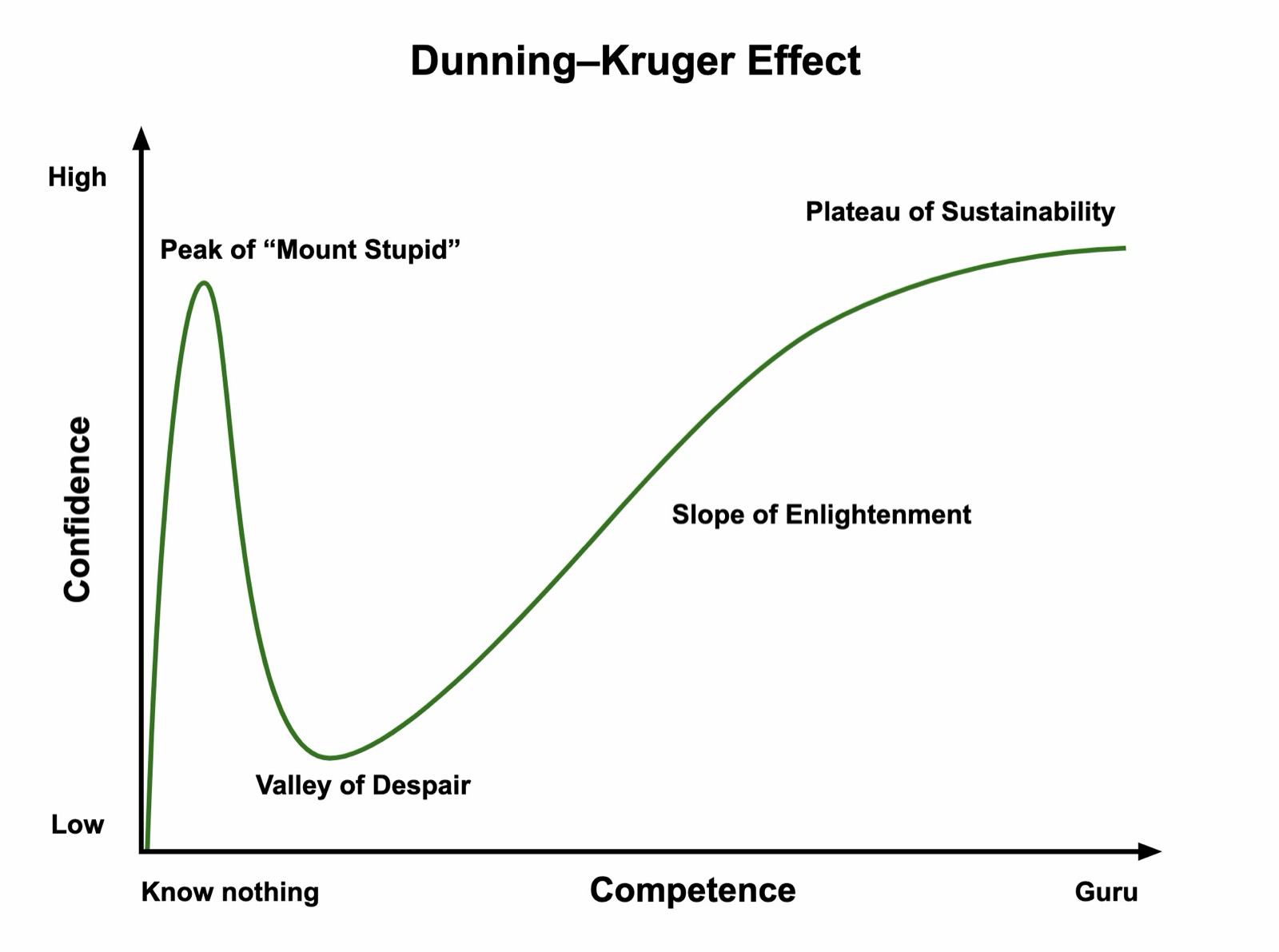
What is the Dunning-Kruger effect?
The Dunning-Kruger effect is a cognitive bias that affects how we judge our own abilities. It describes the phenomenon that people with low competence in a particular area tend to overestimate their abilities. At the same time, they tend to underestimate the abilities of others. Those who actually have high abilities tend to underestimate their competence and wrongly assume that others are as competent as they are. The effect was first discovered in 1999 by the social psychologists David Dunning and Justin Kruger and named after them. They carried out a series of experiments showing that people with low competence are unable to recognise their own incompetence.
An example from a business subject
A vivid example of the Dunning-Kruger effect in a business subject is the topic "stock trading and investing". Let's say a student has just completed their first economics seminar on the topic and now believes they are an expert in share trading. They might have unexpected success, perhaps due to a randomly lucky investment. This success reinforces their belief that they are a stock market guru, even though they only have basic knowledge. As a result, they increase their involvement and invest larger sums without fully understanding the risks or the market. Unfortunately, their lack of competence leads to bad decisions, and they lose considerable amounts of money. A student who doesn't know about the Dunning-Kruger effect might dismiss this failure as bad luck instead of critically questioning their own abilities and continuing to learn.
What can a student take away from this effect that will help during their studies?
The Dunning-Kruger effect holds some important lessons for students that can help them on their learning journey:
- Self-reflection is key: Honest self-assessment is crucial. Be willing to recognise your own strengths and weaknesses, and strive to keep improving. If you're not yet very skilled in a subject, that's okay – it's a normal part of the learning process.
- Recognise knowledge gaps: The effect reminds us that we can't know everything. Identify your knowledge gaps and actively look for ways to close them. Use your university's resources, such as libraries, online courses and tutorials, to deepen your understanding.
- Be open to criticism and feedback: Accept constructive criticism and feedback from professors, fellow students and tutors. It's a valuable tool for improving your skills and overcoming weaknesses.
- Keep learning: The learning process is never finished. By being aware that there is always more to learn, you stay humble and motivated to keep developing. Overall, the Dunning-Kruger effect is an important aspect of human behaviour that reminds us that there is always room for improvement for each of us. By being aware of this cognitive bias, we can make better decisions and make our study journey a success.
I hope this blog post helps you understand the Dunning-Kruger effect better and how you can use it to your advantage in your studies. Good luck and enjoy your academic journey!
Sources:
- Kruger, J., & Dunning, D. (1999). Unskilled and unaware of it: How difficulties in recognizing one's own incompetence lead to inflated self-assessments. Journal of Personality and Social Psychology, 77(6), 1121–1134.
- Kruger, J., & Dunning, D. (2002). Unskilled and unaware – but why? A reply to Krueger and Mueller (2002). Journal of Personality and Social Psychology, 82(2), 189–192.
- studying
- criticism
- learning
- self-reflection
- psychology
- Dunning-Kruger effect
- overconfidence
Comments (0)
Preview: comments aren't stored yet, they only stay in this browser.
No comments yet. Be the first.