


Academic papers and AI at HSG – what is allowed and what to watch out for
Can you use AI for your academic paper at HSG? Find out which rules apply, how to declare AI correctly and what you really need to watch out for when using AI.
 Maximilian FranzHead of Business Development · 22 July 2026 · 5 min read
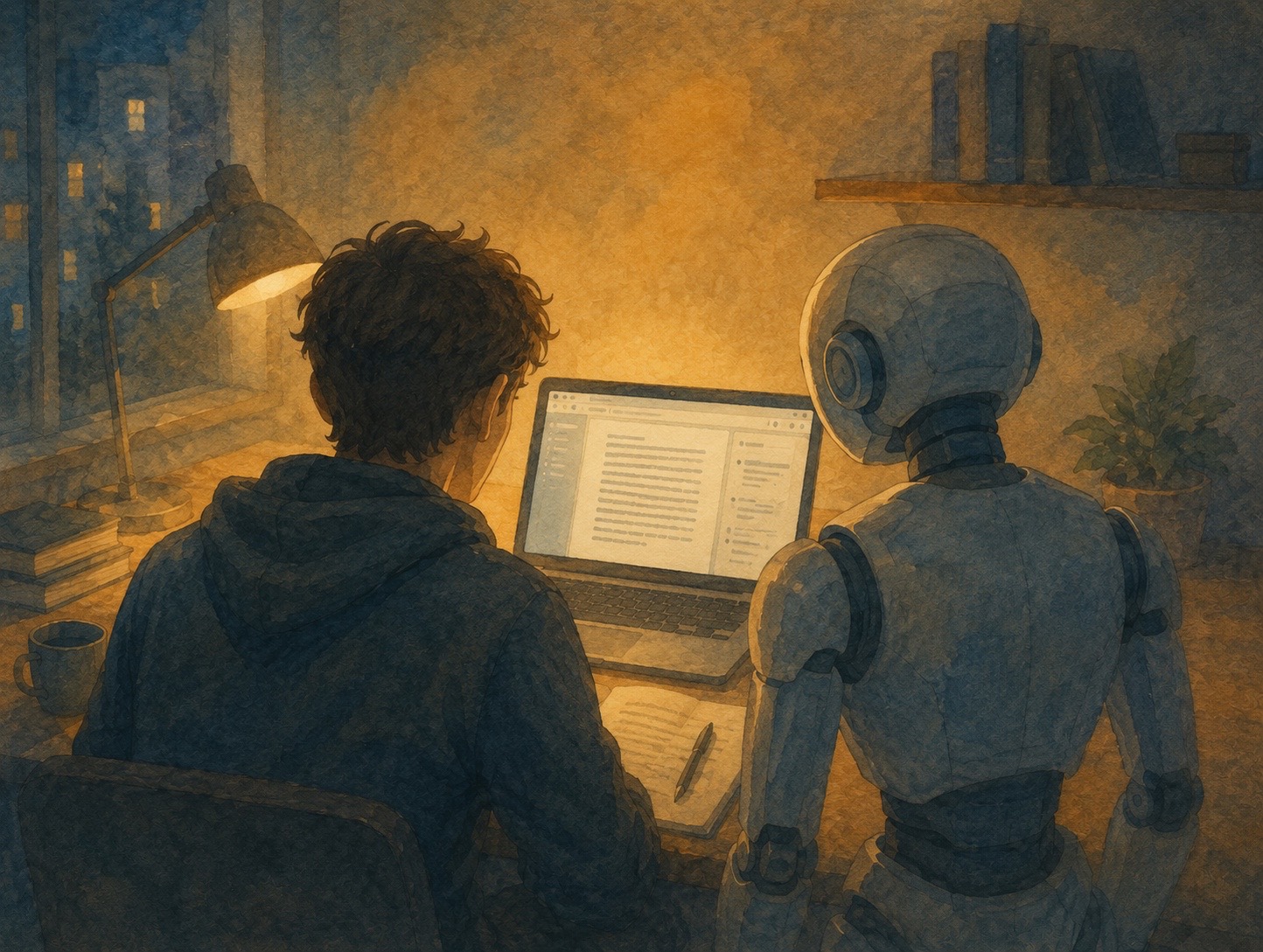
You are writing your first paper at HSG and you have heard the stories: AI = plagiarism? A 1 – the lowest grade on the Swiss 1–6 scale – thanks to ChatGPT? Or your lecturer bans you from using AI? What now? To what extent can you use AI, and where are the limits?
Using AI for academic papers at HSG is generally allowed, as long as the academic work remains your own and the use of AI is declared correctly. Whether and how AI is allowed in your course is set out in the course and examination fact sheet; lecturers can set additional requirements. For example, you may have to submit your prompts or AI outputs, or document your use of AI in more detail. So it is always worth checking the course or examination fact sheet and any additional information from your lecturer.
You can find out how the University of St.Gallen allows you to use AI on StudentWeb under Written work > Working with AI. Before writing your first paper, it is a good idea to read these points carefully and follow them, so you are on the safe side.
Below is a summary of the most important points HSG lists on using AI when writing papers.
AI for academic papers: what is allowed?
HSG allows AI to be used for the following purposes, among others:
- Brainstorming and inspiration as a starting point for your own thinking.
- AI-generated texts or images as the subject of an analysis.
- AI-generated images or graphics for illustration.
- Data analysis, programming or other research methods, provided the use of AI is made transparent.
- Transcription of audio or video material.
- Translations to help your own reading comprehension.
- Translations within your own text.
- Language editing of your own text (grammar, spelling, style).
- Paraphrasing other people's texts, provided the meaning is preserved and the use of AI is declared correctly.
What is not allowed?
- Using AI without declaring it correctly.
- Using AI as a source of facts or academic findings.
- Taking over content without critically checking it yourself.
- Paraphrasing other people's texts with AI without correctly stating the use of AI.
- Entering confidential, personal or copyrighted data into AI tools without consent.
Now you are probably wondering: How can you use AI for writing without risking plagiarism?
Don't worry: using AI does not automatically make your paper plagiarism. What matters is how you use it. If you use AI as support, check everything critically and declare it properly, you are on the safe side. Here are our best tips:
What should you watch out for?
- Use dashes deliberately: Use dashes sparingly. A comma or a new sentence often reads more smoothly.
- Swiss spelling: At HSG, Swiss spelling applies – so always ss instead of ß. AI tools like ChatGPT usually write in German (Germany) spelling, so check for it.
- Write academically, but not overcomplicated: AI tends to use unnecessarily academic terms. Words like operationalisation, conceptualisation, implications, determinants or paradigm may sound academic, but they are not always needed. Only use technical terms where they really fit the content and where you would use them yourself. A clear and precise writing style is usually more convincing.
- Vary your phrasing: Words like moreover, furthermore, consequently or accordingly quickly repeat themselves in a text. Vary your language and write in your own style.
- Not every sentence needs three adjectives: AI loves phrases like “clear, structured and efficient” or “sustainable, innovative and future-oriented”. That's not wrong, but it shouldn't appear in every other sentence.
- Stick to your own writing style: Your paper should sound like you throughout. Revise sections where AI helped you so they fit the rest. And yes, it is tempting to let ChatGPT summarise everything for the conclusion – but that is exactly where you show your own work, so write it yourself.
- Sources, sources, sources: AI can invent sources or reproduce them incorrectly. So check every source and every statement before you use it. If you do not cite a source, for example in the conclusion, make sure you wrote the statements 100% yourself. If you have no source, it is also better to phrase things as assumptions. For example: this suggests that..., it can be assumed that... or it can be inferred that… This signals your own interpretation.
- Don't forget gender-inclusive language: AI texts often don't use gender-inclusive language automatically. If you use it in your paper, you should consistently adjust AI-generated or AI-edited texts too. If you use the colon form (:) for gender-inclusive German and apply it uniformly throughout, the text reads consistently and carefully.
- Don't just copy and paste: If you take text straight from an AI tool, it often brings in different quotation marks («…», „…“, "...") or apostrophes than the rest of your paper. So always check the formatting after pasting and adjust quotation marks, apostrophes and spacing so your document looks consistent. Always revise the text yourself and check the formatting at the end.
- Be careful when simplifying and summarising: When simplifying or summarising, AI sometimes changes the content without you noticing. Technical terms are replaced with more general words, important qualifications get lost or statements are oversimplified. So always compare the AI output with the original and check that the statement still says the same thing.
- Better to declare too much than too little: A properly kept list of aids can save you a lot of trouble. Depending on the lecturer, a general declaration is enough; others also want to see prompts or screenshots.
Example of a simple declaration
| Tool | Purpose | Scope |
| ChatGPT | Improving sentence structure and finding synonyms | Entire paper |
| Claude AI | Final proofreading for grammar and spelling | Entire paper |
Example of a detailed declaration
| Tool | Purpose | Prompt | Evidence | |
| ChatGPT | Language editing | You are a student at HSG writing an academic paper for the course “[course name]”. Edit the language of the text. Only improve grammar, spelling, sentence structure and flow. Do not change any content and do not add any new information. | Screenshot of the conversation | |
| Claude AI | Final proofreading | Proofread my entire paper. Create a page-by-page list of all errors found. For each error, give the page, the location, the type of error (grammar, spelling, punctuation, formatting or style), a suggested correction and a short justification. Do not make any changes directly in the text and do not change the content. | Screenshot of the conversation |
How to prompt properly:
Prompting properly is also an important part of using AI. Don't just write “Make this better.” The more information you give the AI, the better it can support you. Give the AI a role, explain the context and tell it exactly what to do and, above all, what not to do.
❌ Bad prompt
Make this text better.
✅ Better prompt
You are a student at HSG writing an academic paper for the course “[course name]”. Edit the language of the following text. Only improve grammar, spelling, sentence structure and flow. Do not change any content, do not add any new information, and keep an academic but understandable writing style as well as Swiss spelling (ss instead of ß).
One last important thing
If you are unsure, the rule is always: Better to rephrase once more than to simply take over an AI text.
As long as you declare your use of AI correctly, check all sources, don't take over invented information or sources, and the academic work comes from you, you don't need to worry about plagiarism.
Need support?
If you have more questions about using AI or need support writing your paper, just get in touch – we're happy to help!
- HSG assessment year
- AI in academic writing
- academic papers
- HSG AI rules
- HSG
- ChatGPT
- Claude
Comments (0)
Preview: comments aren't stored yet, they only stay in this browser.
No comments yet. Be the first.